
James Weldon Johnson
Metal-on-Metal Hip Replacement
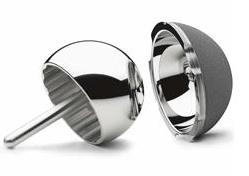
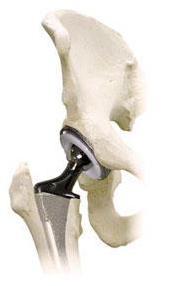
Total hip replacement by far is the most successful orthopedic operation for treating joint damage. About 700, 000 joint replacement surgeries are performed each year, with $ 2.5 billion spent on the material. However, the postoperative revision rate (e.g. ~50% in year 1996) is still
very high, largely due to the artificial replacement failure and creation of wear debris in the surrounding tissue.
A hip replacement consists of two parts: a formal ball
and a socket. (See images on right from Zimmer Inc.).
The current generation of metal-on-metal prosthetic is made of Co-Cr-Mo
alloys (ASTM 1547), with ~60% Co, 26% Cr and 5-7% Mo. The alloy can be as
cast or wrought, the grain size ranging from a few microns to millimeters.
The Co-Cr-Mo alloy adopts a metastable f.c.c. matrix at room temperature,
with some h.c.p.-martensite formed through strain-induced transformation. In
addition, a small amount of M23C6 (M: Cr, Co) carbides are present in the
matrix. Metal-on-metal hip replacements have recently lost popularity, yet we are still interested
in this alloy as it is a commonly used biomedical and engineering alloy.
The current research in our group is to understand the wear and corrosion mechanisms of the Co-Cr-Mo alloy. We study the hip replacement system from a materials science perspective, focusing on the intersections of wear, tribology, and corrosion. Previous work has explored the surface structure, which consists a thin nanocrystalline layer formed through recrystallization. Other work has looked into the composition, formation, and wear of the tribolayer that forms on the metal-on-metal hip replacements during implantation. Additonally, the corrosion properties of the alloy were examined, focusing on the heat treatment's effect on the localized grain boundary pitting corrosion and the relation to crystallographic orientation.
The structural and mechanical properties of the surface from nano to micro-scale can be identified using nanoindentation, XPS and other surface characterization techniques. The primary techniques for this project exploit state-of-the-art analytical electron microscopy (TEM/STEM/EDS/EELS). This research will illustrate the wear and corrosion processes of metal-on-metal hip implants, and provide us the
insight that is essential for designing next generation of joint replacement materials.
For this project, we closely collaborate with Dr. Jacobs and Dr. Wimmer's group at Rush University Medical Center in Chicago, Dr. Fischer's group at Germany, and Dr. Shull's group at Northwestern University. This collaboration was previously funded by an NIH stimulus grant.
Recent Publications
-
The effect of contact load on CoCrMo wear and the formation and retention of tribofilms
M.A. Wimmer, M.P. Laurent, M.T. Mathew, C. Nagelli, Y. Liao, L.D. Marks, J.J. Jacobs and A. Fischer
Wear, 2015. 332333(0): p. 643-649
-
Nanoscale Abrasive Wear of CoCrMo in In Situ TEM Sliding
Liao, Y., E. Hoffman, and L.D. Marks
Tribology Letters, 2015. 57(3)
-
Intergranular pitting corrosion of CoCrMo biomedical implant alloy
Panigrahi, P., Y. Liao, M. Mathew, M.A. Wimmer, J.J. Jacobs, and L.D. Marks
Journal of Biomedical Research, 2013, 102B, 850-859
-
Towards Understanding Tribocorrosion in Hip Replacements.
Hoffman E., Liao Y. and L.D. Marks
Microscopy and Microanalysis, 19 (2013)176-177
-
Microstructure of Retrievals made from Standard Cast HC-CoCrMo Alloys
Stemmer, P., Pourzal, R., Liao, Y., Marks, L. D., Morlock, M., Jacobs, J. J., Wimmer, M. A., Fischer, A.
ASTM Selected Technical Papers 2013, DOI:10.1520/STP156020120033
-
Tribochemical Reactions in Metal-on-Metal Hip Joints Influence Wear and Corrosion
Wimmer, M. A., Mathew, M. T., Laurent, M. P., Nagelli, C., Liao, Y., Marks, L. D., Pourzal, R., Fischer, A., Jacobs, J. J.
ASTM Selected Technical Papers 2013, DOI:10.1520/STP156020120050.
-
CoCrMo metal-on-metal hip replacements
Y. Liao, E. Hoffman, M.A. Wimmer, A. Fischer, J.J. Jacobs, and L.D. Marks
Physical Chemistry and Chemical Physics. , 15 (2013) 746.
-
Graphitic Tribological Layers in Metal-on-Metal Hip Replacements (Supporting Info)
Y. Liao, R. Pourzal, M. A. Wimmer, J. J. Jacobs, A. Fischer and L. D. Marks
Science 334 (2011) 1687